5 Tricks To A Well-Painted Guest Room in Denver Metro, CO
You may well be aware that a guest room is not at the forefront of your thoughts when it comes to updating the look of your home, seeing as it only gets used when you have a guest present to take advantage of it.
As you want your guest to be well received, it helps if your room is painted well and doesn’t have that certain house of horrors look to it, in the sense that it should be nicely painted (though if you have the kind of friends who may enjoy a frightful guest room there are ways to accommodate them as well… perhaps a topic for a future article?)
Let’s now look at and consider five tricks to a well-painted guest room in Denver Metro, CO
1. Think About What Colors Will Look Nice
There are few people who know the kinds of people that are going to be spending time in your guest room better than you — they’re going to be your overnight guests, after all.
If you have a variety of guests that are going to be coming to your home, you can of course choose colors that are going to be pleasant for everyone — you don’t want to choose colors that are going to be nice for some of your guests but rather unpleasant for others, after all.
There are a lot of colors that are more neutral as it were, but then again you may find that these colors can be quite bland and that brighter colors would make your visitors feel at home.
2. Properly Clean The Walls Before Painting
In terms of getting the walls ready for a good paint job, there are a few things that are going to be as fundamentally important to make sure it gets done right, such as properly cleaning the walls.
In doing this, you’ll eliminate all kinds of dust and grime that may well be on the surface of your walls. You’ll also be doing yourself a favor by being able to spot flaws in the surface that will need to be treated sooner rather than later.
These will include areas of the wall where the surface is rougher than others, and possibly holes in the wall that need to be corrected. If you run into any issues like holes or cracks, you may want to consider skim coating for a smoother finish.
3. Remove Furniture If Possible
When you find yourself painting in your guest bedroom, it will be a good idea to remove as much of the furniture from the room as you can, including that comfortable bed and those accompanying bedside tables.
This will be not only because it can be a bit of an impediment (having the furniture there), but the more things you have in the room, the more you will have to go out of your way to ensure that paint doesn’t get on the things that are there.
Of course, it’s not always possible but you should do your best to remove the things in the room.
4. Darker Colors Go More Easily Over Lighter Colors
In terms of painting, if you find that you have a darker wall already, it will be a lot more difficult to switch to a lighter wall than it would be if you had a lighter wall and wanted to paint over a darker color.
This is not to say that it’s impossible, of course — you just have to bear in mind that you will likely have to take extra steps in getting the walls ready to be painted.
5. Choose The Right Gloss
Lastly, you should take some time to think about what the different glosses mean and how they pertain to the use of the guest room.
If you think you’re going to have to spend time cleaning the walls after, perhaps, a guest stays with children, it would be worth using a glossier paint that is easier to clean.
Otherwise you can make use of a flat paint and enjoy the benefits of that paint over a glossier paint.
FAQ
Q: What is the best paint finish for a guest bedroom?
A: The best paint finish for a guest bedroom really depends on how much activity the room sees. If you’re expecting kids or messy guests (no judgment), a satin or eggshell finish makes cleaning a lot easier. For a quieter, more decorative space, a flat or matte finish can give you a softer, cozier vibe. Just keep in mind that flatter paints show more wear over time—so if scuff marks bother you, a bit of gloss might be worth it.
Q: What is the coziest bedroom color?
A: Cozy is subjective, but warm neutrals tend to make a guest bedroom feel like a hug in color form. Think soft taupe, warm beige, dusty rose, or even a muted olive if you’re feeling adventurous. These tones invite comfort without overwhelming the senses. It’s less about being trendy and more about creating a space your guests want to curl up in.
Q: What is the most positive color for a bedroom?
A: A soft yellow or a muted sky blue often brings a cheerful, uplifting energy to a bedroom without shouting for attention. These colors feel optimistic and bright—like sunshine or a clear day—without being overwhelming. Pair them with light bedding and warm accents for a fresh and happy space. It’s a subtle way to lift the room’s vibe without going full neon.
Don’t settle for just any painter when you can get the attention to detail and professionalism from Imhoff Fine Residential Painting in Denver Metro, CO. Call us today to speak with one of our professional color consultants.
5 Tips For Cleaning Your Popcorn Ceiling in Denver Metro, CO
If you have a popcorn ceiling in your home, you have something increasingly rare — most people no longer install them, and many who do have them eventually look into how to remove a popcorn ceiling entirely due to the mess and maintenance.
For those people who like the look of their popcorn ceiling enough that they want to keep them (or don’t want to bother with the process of removing them) and as such, cleaning is something that comes up now and then.
With that being the case, here are five tips for cleaning your popcorn ceiling in Denver Metro, CO.
1. Test For Moisture Sensitivity
Before you start cleaning your ceiling, you need to know if it is sensitive to moisture and what extent.
You want to do this because there are various sensitivity levels that a popcorn ceiling can have to moisture, ranging from light sensitivity, meaning that you can use a little liquid to clean, to extreme sensitivity, meaning that any exposure to liquid would cause damage.
If you test out a small area of the ceiling, you will be able to ascertain if your ceiling is, in fact, sensitive to moisture.
2. But First, Test For Asbestos
Actually, before you do anything else, you should be sure that your popcorn ceiling does not contain asbestos — a rather toxic substance that is quite bad for your health and made up a lot of popcorn ceilings made up until the late 1970s.
If your home was built before 1979, there is a chance that your popcorn ceiling could contain asbestos — and if that ends up being the case, you are not going to be able to clean it yourself but rather will have to hire a professional company that will be able to do it for you.
There are various testing kits to see if your ceiling has asbestos — and it’s well worth testing before you get started.
3. Dust — And Spider Webs And Cobwebs
When you have dust or even spiderwebs or cobwebs on the surface of your popcorn ceiling, it can look quite unpleasant.
You need to bear in mind that it is more than just a nuisance – it is something that you have to clean up not too long after you see it as it can really dirty up your ceiling in the long term if you don’t take care of it.
Get a good feather or microfiber duster, and you’ll be able to remove this surface dust from your popcorn ceiling properly.
For a particularly bad spiderweb problem, you can turn to special tools that can really grab onto the web and remove it.
4. Dabbing Is Best
Even if your popcorn ceiling can stand up to a little bit of moisture, it’s best to limit how much it gets, and so when you make a good cleaning solution (perhaps of dish soap and water to tackle grease, for example), you shouldn’t spread it on as much as you should dab it where needed.
By doing this, you don’t get your ceiling too moist and therefore don’t possibly cause significant damage to it – it’s really the safest way to go about doing it.
5. Duct Tape For Dust
Lastly, consider the strength of duct tape and a good long handle — for taking on some really hard to reach dust.
All you have to do is to wrap some duct tape, sticky side out, of course, around a long handle (like a broom handle), and then poke the newly crafted sticky trap up toward the dust.
It’s important to note that you have to occasionally change the duct tape as it will get dirty and lose its ability to capture new dust.
Don’t settle for just any painter when you can get the attention to detail and professionalism from Imhoff Fine Residential Painting in Denver Metro, CO. Call us today to speak with one of our professional color consultants.
7 Ideas For Best Ceiling Painting Practices in Denver Metro, CO
When you’re looking to paint the interior of your home, you sometimes will look to the various walls of the home as well as the different furniture, etc.
One place people do not look very often, for one reason or another, is the ceiling — it’s sometimes called the hidden wall in your home.
Despite this, it does need to be painted on occasion (and you can tell when it needs it!), and when this happens, it’s good to approach it with good knowledge on how to do it right.
With that being the case, here are seven ideas for best ceiling practices in Denver Metro, CO.
1. Use Heavy Drop Cloth To Protect The Floor
When you are painting the ceiling of your home, there will inevitably be some drips — it happens because of the nature of paint.
The best thing you can do to protect your floors is to use heavy drop cloth — it can be purchased at a good hardware store and some paint stores.
The reason that heavy drop cloths are more recommended over lighter drop cloths is that lighter drop cloths and tarps tend to shift under your weight as you walk about, and they therefore, leave the floor vulnerable to drips.
2. Use A Portable Ladder And Not A Makeshift Scaffold System
If you don’t have a long enough telescoping paint roller, you might think that it’s a good idea to make a scaffold system with a couple of large buckets, perhaps, and a plank.
It is far better to acquire for yourself a ladder of some sort and to use that instead, being careful not to go over the next to last or the top step as these are the most dangerous when it comes to accessing the ceiling.
Additionally, ladders are better because they are far more portable.
3. Remove Furniture From The Room Being Painted
The furniture from the room where the ceiling is being painted should be entirely removed as it is the best way to prevent paint from dripping onto it.
The alternative to this is that you can move the furniture that cannot be removed to the center of the room and then cover that furniture with heavy drop cloth.
4. Make Sure The Telescoping Handle Is Not Too Big
If you are not using a ladder or some other means to access the ceiling but rather are using a telescoping handle for your paint roller, you want to make sure that the handle is not too big when fully extended.
You might think that the length isn’t important so long as it reaches — but this is not at all the case.
If the handle is too long, you will find that it is going to be much more challenging to handle while it is partially collapsed and therefore makes the entire painting process more difficult.
5. You Do Not Need An Official Paint Roller Handle
Some will have you believe that the only kind of handle that you have for your paint roller is some kind of official handle meant for paint rollers.
This is not the case as you can use many kinds of handles, including the sort of handles used for brooms and the like.
6. Sand First
Even though you are painting the ceiling, you are still better off sanding before you paint your ceiling.
Sanding the ceiling will best help it take the primer and paint coats that will follow.
7. Ceiling First
If the whole room is on your agenda for painting, you should start with the ceiling. It’s the best in terms of planning and getting things done in a more timely manner.
Should you skim coat your ceiling prior to painting? If you see any cracks or damage or if you just want a nice, smooth surface and a paint job that lasts longer, you might consider skim coating.
Don’t settle for just any painter when you can get the attention to detail and professionalism from Imhoff Fine Residential Painting in Denver Metro, CO. Call us today to speak with one of our professional color consultants.
Color Ideas For Your Brick Exterior in Denver Metro, CO
We have previously discussed the notion of whether or not it was a good idea to paint your brick exterior — it should be understood that if you are reading this article, you came to the conclusion at the end that it was a good idea for you.
The question you are no doubt faced with once you decide that you do want to paint your brick home is what color you’re going to want to choose.
The good news is that even though you can’t really go back in time as it were with painting brick — in that you cannot un-paint a brick exterior — you can always go with a different color option over top the one you have if you end up not liking the way that your brick exterior looks after painting it.
With that in mind, here are some color ideas for your brick exterior in Denver Metro, CO.
White
White is the kind of color that would raise an eyebrow at first glance, making one wonder why a person would choose to paint the house such a simple color.
In terms of painting your brick house exterior, however, white is one of the best colors that you can choose, though of course, you are going to find yourself having to spend a bit more time cleaning it as a result of how easily you will be able to see the dust and grime on the exterior.
The good thing about white as far as exterior house color goes is that it will actively keep the interior of your home cooler.
The same can be said, the opposite in any case, if you happen to decide to paint the exterior of your home black — though some might say that it would be a good choice if you live in an area that has a lot of cooler falls and winters throughout the year.
Aqua
The color aqua brings to mind the sea, which is a tranquil kind of paradise for the eyes.
People that choose to paint the brick exterior of their homes aqua do so with the hope and the expectation that they can impart some of that tranquility onto the exterior of their homes.
In terms of look, some would even say that this paint color gives what could be described as a coastal look/vibe.
Creamy
If you are looking to paint your natural brick home a lighter color but you don’t want to actually go all the way white, you can paint your brick exterior a creamy color and get the benefits of having it be a lighter color without some of the downsides of having a purely white house.
The creamy kind of exterior paint job for your brick home will have a mostly neutral look to it without having any sort of yellow or banana look, which is certainly not a look you want to go for unless you do… in which case why not just go for banana yellow itself?
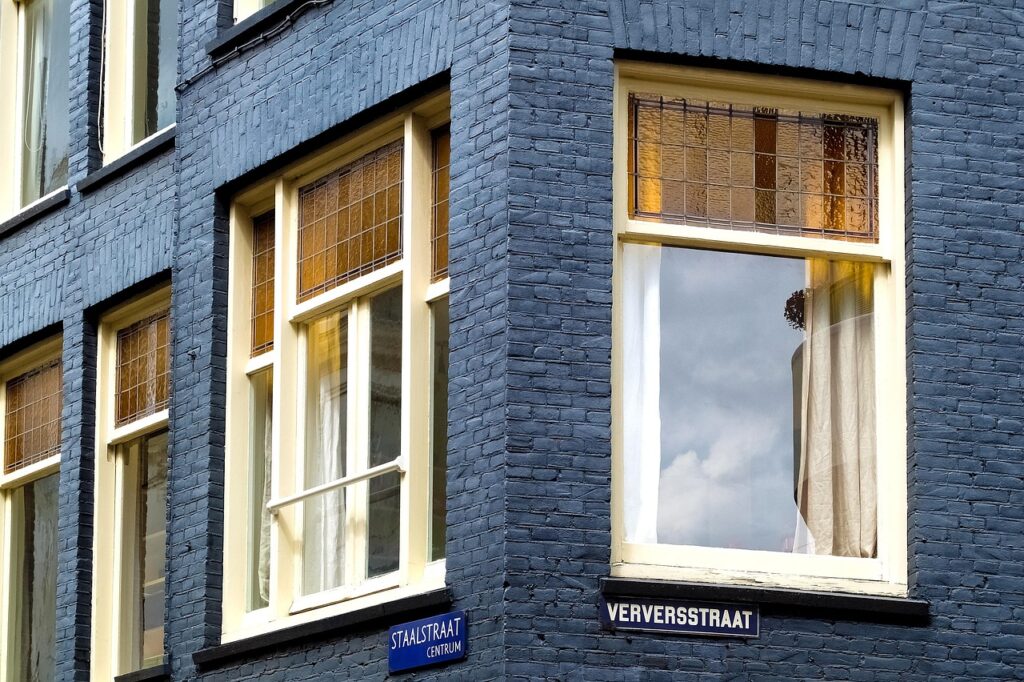
Dark Blue
Dark blue, as far as exterior paint jobs go, is on the spectrum of being close to being navy but isn’t quite there.
If you’re a fan of having a darker color brick exterior but you don’t want to have a black house, dark blue may be the kind of color you’re going to want to use.
It can sometimes invoke thoughts of the deep sea and going out onto the ocean and looking out into the deep expanse which may or may not be the kind of thing you want to think about when looking at the brick exterior of your home.
Don’t settle for just any painter when you can get attention to detail and professionalism from Imhoff Fine Residential Painting in Denver Metro, CO. Call us today to speak with one of our professional color consultants.
FAQ
1. What kind of paint do you use for brick?
For painting brick exteriors, it’s recommended to use high-quality acrylic latex paint designed for masonry surfaces. This type of paint offers durability, breathability, and resistance to moisture, ensuring a long-lasting finish.
2. Is painting brick a good idea?
Painting a brick exterior can enhance curb appeal and make the surface easier to clean. However, it’s a permanent decision, as removing paint from brick is challenging. Additionally, if moisture becomes trapped beneath the paint, it may lead to brick deterioration over time.
3. Should you paint brick with a roller or a brush?
When painting brick, a combination of tools is often best. Start with a high-quality brush to cut in around edges and corners, ensuring detailed coverage. Then, use a roller with a thick nap (¾ inch or more) to cover larger brick surfaces, allowing the paint to reach into crevices and provide even coverage.
5 Avoidable Errors When Painting Your Bedroom in Denver Metro, CO
When you are working on going about making your home a better place for you to live as well as general upkeep and maintenance, one thing you might consider is the repainting of one or more bedrooms.
The thing is that when you paint, it’s entirely possible that you could end up making errors that will be quite costly — and yet they are easy to get around if you are aware of them.
As this is the case, here are five avoidable errors when painting your bedroom in Denver Metro, CO.
1. Not Cleaning The Walls
A nearly surefire way to getting your walls painted improperly is to start by neglecting to clean them.
You may well be thinking that your walls are sufficiently clean, and that could be the case for the most part, but not when it comes to painting your walls.
Even the most minute amount of dust and dirt on your walls is bound to get that much worse when you have applied a coat of primer and then coats of paint to them — and seeing as the foundation of a good paint job is having a smooth surface, you won’t do well by having a dirty surface.
Do yourself and your paintwork a favor by starting with a clean surface.
2. Not Allowing The Walls To Dry
You may be wondering what specifically is meant by not allowing the paint to dry — does this mean after you have applied the final coat of paint?
Of course, it is important to allow your walls to dry when done, but there is much more to it than this.
After the step by step process that involves the walls getting wet in any sense — whether this is after you have properly cleaned your walls (see above) or after you have applied a coat of primer or even the first coat of paint.
3. Starting The Painting Project With No Plan
It’s true that you can start a painting project such as painting the walls of your bedroom and have no plan for it whatsoever.
The only issue with this approach is that it will take an indeterminable amount of time for you to get the painting work done, and you may end up spending a lot more money on it than you would if you would carefully plan out the work.
For example, it’s quite easy to buy more gallons of paint than you will actually need if you don’t take the time to take measurements of the walls that you are going to be painting.
4. Using Cheap Equipment
You may be of the impression that it’s not such a big deal if you buy your paint rollers from the cheaper section of the store — after all, as long as it is a paint roller and can hold a bit of paint, that’s all that matters, right?
This is not at all the case — paint rollers that are more bargain bin tend to shed while you are painting — you end up with bits of the roller in the paint on the wall, and that just means you have to clean up the paint.
You’re much better off in the long run getting higher-end equipment or even borrowing equipment from friends or family that paint more often.
5. Improperly Protecting The Room
When you’re painting the bedroom or any other room for that matter, you need to make sure that you have protected the areas of the room that aren’t actually being painted,
You should also take the time to protect the floor by using things like tarp or plastic drop cloths such that the paint you are using to paint the walls doesn’t end up on the floor as well.
Don’t settle for just any painter when you can get the attention to detail and professionalism from Imhoff Fine Residential Painting in Denver Metro, CO. Call us today to speak with one of our professional color consultants.
FAQ
Is it better to cut in or roll paint first?
It’s best to cut in first, painting edges and corners with a brush before rolling. This helps blend the roller application smoothly and avoids visible brush marks.
Roll walls – Use a “W” or “M” pattern for even coverage.
Paint trim & doors – After walls dry, paint baseboards and doors.
Touch up – Fix drips or missed spots as needed.
What is a common mistake when painting with a roller?
A common mistake is overloading or underloading the roller, causing drips or patchy coverage. Always load evenly, maintain a wet edge, and use light, consistent pressure.